Received a violation? Call 1 (347) 378-9376. We respond within 2 hours.
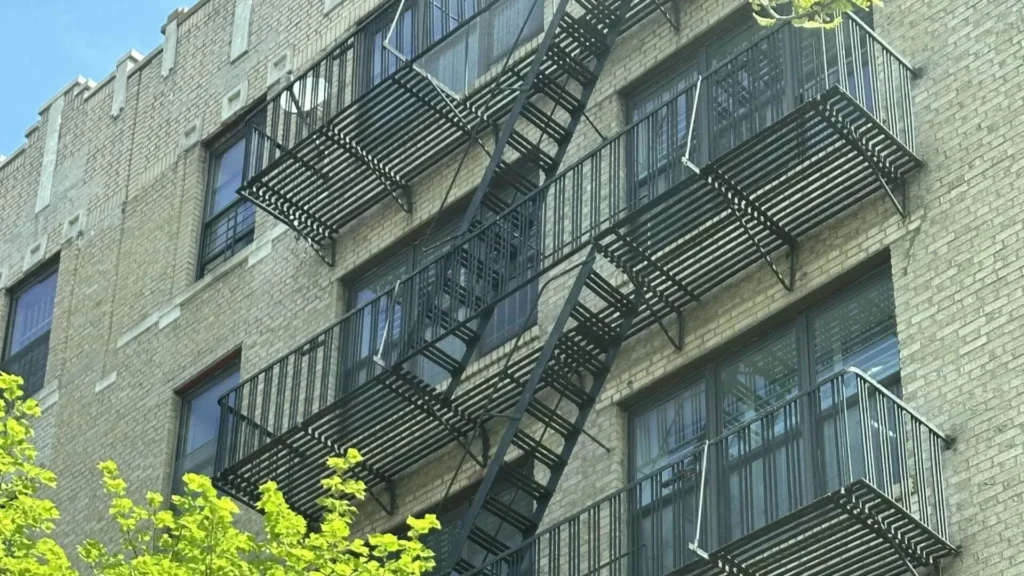
Local Law 11, better known as FISP, requires fire escapes to stay safe and free of corrosion. If the coating’s worn through, repainting is usually what gets you back into compliance.
Let it go too far, and you’re often looking at sidewalk shed costs that can run roughly $20 to $40 per linear foot per month, depending on the project. ECB fines between $5,000 and $25,000, and a 90-day clock that starts ticking the day your inspector files. We’ve cleared violations for 600+ Brooklyn building owners.
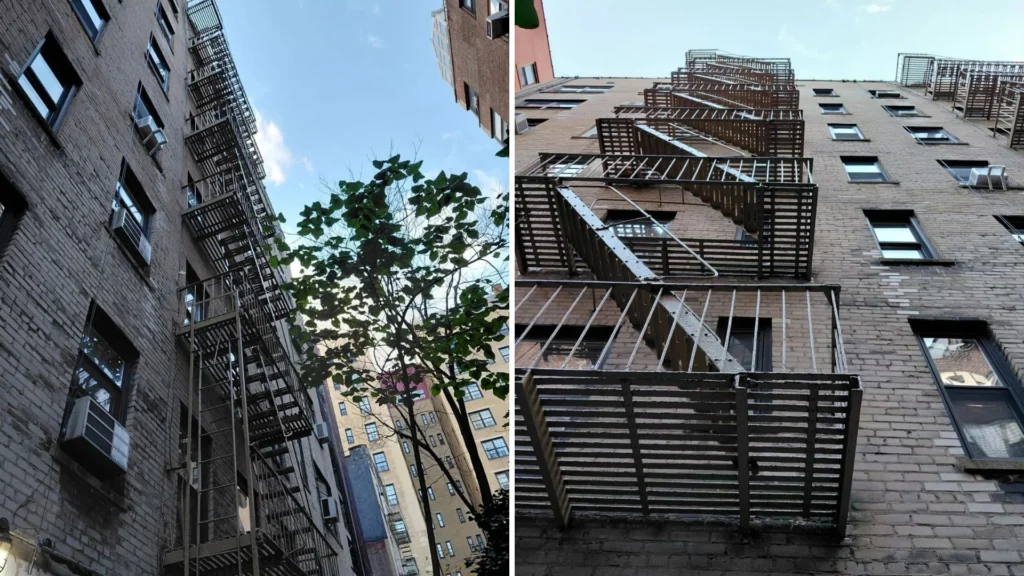
A quick rundown of where the law came from and what it actually requires of your building.
Local Law 11 passed in 1998, building on Local Law 10 from 1980. Both came after fatal facade incidents in New York City. These days it’s known as FISP, the Facade Inspection Safety Program, and it runs under NYC Administrative Code §28-302.
Fire escapes are covered directly. Every five years, a Qualified Exterior Wall Inspector, or QEWI, goes over your building’s exterior walls and everything attached to them, fire escapes included. They’re checking structural connections, platform condition, railing integrity, how the drop ladder operates, and how far corrosion has gotten.
FISP kicks in once a building is taller than six stories. Shorter buildings aren’t off the hook though. They fall under NYC Housing Maintenance Code §27-2014 instead, which requires every fire escape to stay free of corrosion and painted in two contrasting colors, no matter how tall the building is.
Sub-cycle 10B opened February 21, 2026. Block ends in 0, 7, or 8? Your deadline is February 21, 2028, and that window’s open right now.
SAFE. No repairs needed. You’re compliant, and nothing more happens until the next cycle.
SWARMP. Safe With a Repair and Maintenance Program. Repairs are needed by the date in your report. Miss that date, and it flips to UNSAFE at your next inspection, automatically.
UNSAFE. This one moves fast. Public protection, such as a sidewalk shed or fencing, is generally required immediately for unsafe conditions. A repair plan has to reach the DOB within 30 days. All repairs finished within 90. ECB fines start right away and keep running until your Amended FISP report gets DOB sign-off.
How does the QEWI decide which rating you get? Significant corrosion, coatings that have broken down, or actual structural defects can push a building into SWARMP or UNSAFE territory. A little surface rust on its own usually isn’t enough to land you in the worst category.
DOB fines don’t pause while you decide what to do. Here’s what’s accumulating right now, and how fast it adds up.
Fire escape violation fines in NYC compound daily, and stop-work orders don’t pause while you decide. Call 1 (347) 378-9376 and get it moving today.
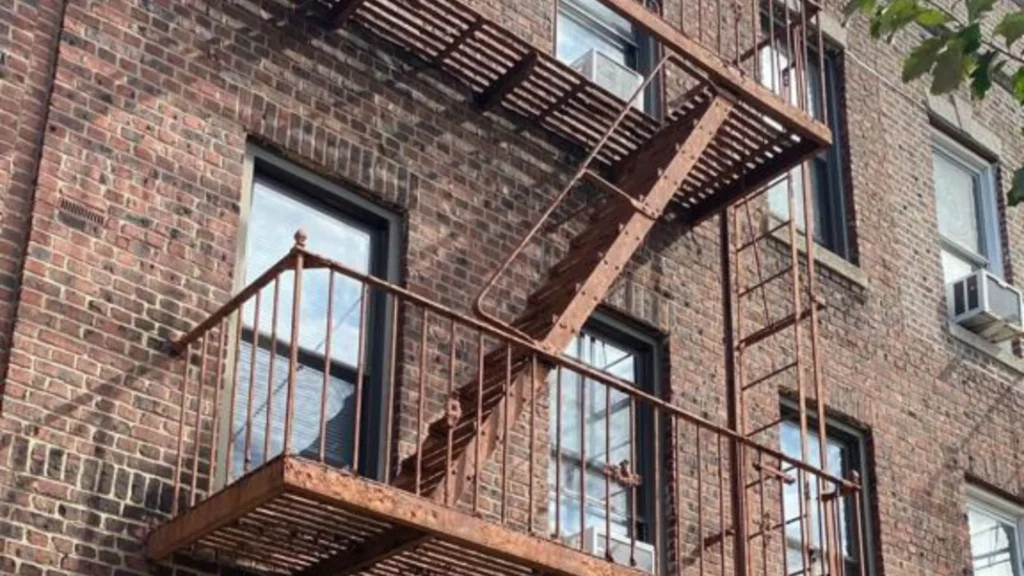
The exact standard your fire escape needs to meet, not just “get it painted.”
NYC Housing Maintenance Code §27-2014 puts the responsibility on the owner: keep the fire escape in good repair, free from corrosion, and scrape off any rust that shows up before repainting.
Our coating system starts with a rust-inhibitive primer applied to all bare metal, followed by two contrasting finish coats in accordance with Housing Maintenance Code painting requirements.
Using contrasting colors makes it easier for anyone inspecting the fire escape later to confirm that both coats were applied. If the first color is still visible through the second, additional coverage may be needed.
Paint isn’t decoration here. It’s the primary protective barrier between bare steel and New York weather. Once it fails, the freeze-thaw cycle starts pushing water into the metal every winter. Out in Red Hook, Coney Island, and Bay Ridge, salt air speeds that whole process up considerably compared to inland neighborhoods.
None of these guarantee an UNSAFE call on their own. The QEWI weighs how bad it actually is before deciding.
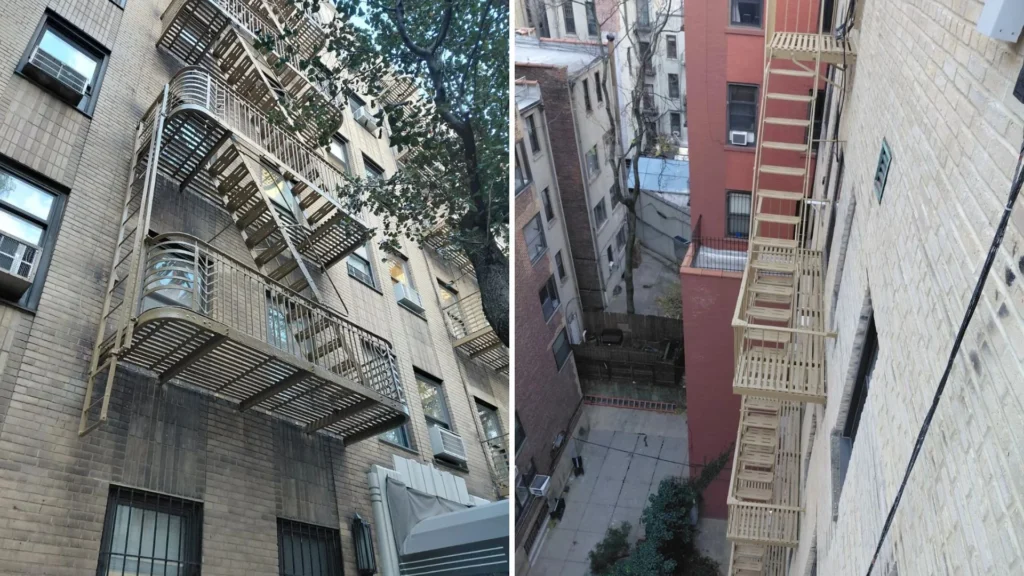
Real numbers on what happens if a violation sits unresolved.
Add it all up, and a building that lets its FISP deadline slide can realistically be looking at $50,000 to $200,000 between fines, shed costs, and legal fees inside a year or two. Painting before any of that happens costs a fraction of it.
Call 1 (347) 378-9376 for a free estimate. Same-day response.
From first site visit to final paperwork, here’s what actually happens once you call.
We start with a free site visit. Every component gets inspected in person, we photograph anything likely to flag during a QEWI inspection, and you get a written condition report before we ever quote a price.
From there, surface prep depends on what we find. Moderate corrosion gets mechanical grinding and wire brushing. Heavy corrosion gets sandblasted down to bare metal, meeting SSPC SP-6 or SP-10 depending on the surface. We don’t prime over rust, ever.
Primer goes on next: zinc-rich or alkyd-based, at a minimum 2-mil dry film thickness, with a second coat wherever corrosion was severe. Then two coats of industrial-grade, corrosion-resistant topcoat in contrasting colors, and our crew checks coverage before anyone comes off the platform.
If there’s structural damage, we handle that too. Cracked welds get re-welded to AWS D1.1, loose anchors get re-bolted, and bad hardware gets replaced. If your Amended FISP report needs a PE sign-off, we coordinate that directly.
Last comes the paperwork: a written work record, before-and-after photos, and a certification statement your QEWI can reference when filing the Amended FISP report. You never have to touch DOB NOW yourself.
Brownstones, coastal buildings, walk-ups, and mixed-use, each one fails differently.
fire escapes on these run 80 to 120 years old, and anything built before 1920 is often wrought iron rather than mild steel. Wrought iron needs a gentler touch than modern steel; grind it too aggressively and you can take off more material than intended, so we hand wire brush these instead. Landmarked buildings may also need LPC sign-off on the color before we start.
salt air corrodes metal noticeably faster out here. A topcoat alone usually isn’t enough, full restoration tends to be the real fix, and most contractors put these buildings on a 4 to 6 year repaint cycle instead of the usual 7 to 10. UNSAFE ratings in these neighborhoods are frequently driven by corrosion.
steel fire escapes from the 1940s through ’60s often carry several layers of old paint, which raises the possibility of lead. We follow EPA RRP rules and document the abatement properly for your records.
these get hit with both DOB FISP enforcement and a separate FDNY inspection. We handle Certificate of Correction paperwork for the FDNY side alongside your FISP compliance record, so one visit from our crew clears both agencies.
Look up your block number at nyc.gov/finance or acris.nyc.gov, then check the last digit against the table below.
Block Number Ends In | Sub-cycle | Window Opens | Filing Deadline |
4, 5, 6, or 9 | 10A | February 21, 2025 | February 21, 2027 |
0, 7, or 8 | 10B | February 21, 2026 | February 21, 2028 |
1, 2, or 3 | 10C | February 21, 2027 | February 21, 2029 |
Get the paint job done before your QEWI shows up, not after. A pre-inspection paint job takes away one of the main reasons a fire escape gets rated UNSAFE in the first place.
Wait until after an UNSAFE rating, and you’re paying for the same paint job anyway, plus violation clearance, plus the Amended FISP report fee, plus whatever ECB fines pile up in the meantime. Getting ahead of it costs less than all of that combined.
Call anytime, 1 (347) 378-9376. We’re picking up within 2 hours, evenings and weekends included.
We’re out in every corner of Brooklyn, Coney Island to Williamsburg, Bay Ridge to Bed-Stuy.
Our crews are licensed and insured, and every job comes with full DOB documentation, no exceptions.
You've got 30 days from the inspection date to get a repair plan filed with the DOB, and 90 days to finish the actual repairs. After that, an Amended FISP report goes through DOB NOW to clear the rating. ECB fines keep running until DOB approves that report, not until the paint's dry.
Yes. NYC Housing Maintenance Code §27-2014 requires fire escapes to stay free from corrosion no matter how tall the building is. FISP is just the inspection mechanism for buildings over six stories; the underlying maintenance rule covers the whole city.
Inland neighborhoods like Flatbush and Crown Heights usually go 7 to 10 years between full repaints. Coastal spots like Red Hook, Coney Island, and Bay Ridge run closer to 4 to 6, since salt air does a lot more damage between seasons out there.
The Housing Maintenance Code requires two contrasting coats of paint after corrosion has been removed. Our standard coating system includes a rust-inhibitive primer followed by two industrial-grade finish coats.
Cycle 10 began in February 2025, with sub-cycle filing deadlines running through 2027, 2028, and 2029 depending on your block number. Look yours up at nyc.gov/finance and match it against the table above.
Every job comes with a written condition report, before-and-after photos, and a certification statement your QEWI can use to file the Amended FISP report. You never have to log into DOB NOW yourself.
Yes. Two-hour response for stop-work orders and FDNY violations too, evenings and weekends included. Those don't wait for business hours, so neither do we.
A standard brownstone runs 2 to 4 days for prep, primer, and both topcoats. Heavier corrosion or structural repairs alongside the paint job take longer. You'll get a real timeline once we've actually looked at the building.
We provide expert rust-proofing, painting, and violation clearance across all 29 Brooklyn neighborhoods. We keep your historic brownstones and commercial properties compliant and safe.
Copyright © 2026, All rights reserved.